
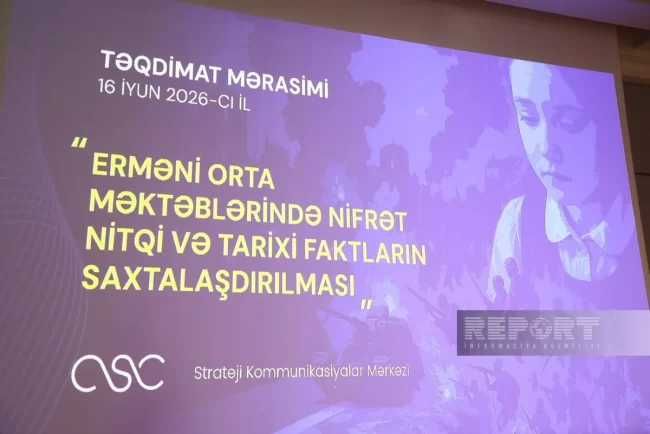
A presentation of the report “Hate Speech and Falsification of Historical Facts in Armenian Secondary Schools” has been held in Baku.
The material was prepared in Azerbaijani and English.
According to Report, speaking at the event, Ali Abdullayev, Deputy Chairman of the Center for Strategic Communications and project manager, stated that the study was based on materials found in educational institutions operating in Karabakh during the occupation.
“During the analysis of more than 1,000 materials, approximately 3,000 cases were identified. The materials can be accessed via QR codes, which we placed in the report itself. For example, on Armenian maps, Nakhchivan is presented as ‘historical Armenian territory,'” he noted.
Abdullayev emphasized that the textbooks and ideological literature studied were published in Yerevan by state agencies.
“These materials were published by government agencies. The hate speech in the books is directed not only against Azerbaijanis but also against the small peoples living in Azerbaijan. Turks are characterized as barbarians, and Azerbaijanis as thieves and robbers,” he said.
Recalling the ongoing peace process between Azerbaijan and Armenia, the project director noted the advisability of removing educational materials containing hate speech against Azerbaijan from circulation in Armenian schools.
In turn, Jabi Bahramov, head of the Western Azerbaijan History Department at the Institute of History and Ethnology of the National Academy of Sciences of Azerbaijan, noted that the Armenian side falsified the history of Azerbaijan both during the Soviet period and after the collapse of the USSR.
“The books taught in Armenian schools, along with hatred of Azerbaijanis, attempt to instill in children the idea that these lands do not belong to the Azerbaijani people,” he emphasized.
Azerbaijani MP Rizvan Nabiyev, in turn, noted that in Armenia, administrative resources of the state were used at various stages and in various forms to fuel hatred towards Azerbaijan.
“Along with the Ministry of Education, the country’s Academy of Sciences also played an active role in this process. This is a matter of state policy. In a war waged by one nation against another, weapons are used only at the final stage. Before that, ideological, diplomatic, and other means are used. In Armenia, we see that people are drawn into ideological wars from childhood,” the deputy stated.
Report